Pour lire l’article en français, cliquez ici.
Contents:
Want to read our exclusive interview? Click here
Want to read our preview directly? Click here
GTAVI — SYMPHONY OF THE NEW WORLD
An exclusive interview with Rob Nelson, Head of Development at Rockstar Games
As a rule, no one gets in here. Especially not at a time when every social media platform is on the lookout for the slightest image, anything that might fuel days of wild speculation. And certainly not just weeks before the release of a video game that, with every new chapter, becomes such an event that its influence extends far beyond gaming, seeping into the worlds of filmmakers, musicians, graphic artists and designers. Behind these walls, the sixth instalment of one of contemporary pop culture’s most significant works is being made: Grand Theft Auto, a series that has spent the past thirty years following the exploits of criminals in fictional American cities.
The team welcoming us to Rockstar North’s offices tells us that the number of people who will get to see what we are about to see is highly selective. Of Rockstar Games’ eleven studios, this is perhaps the most well-known. Located in Edinburgh, the elegant building stands beside the Scottish Parliament, nestled beneath the serene cliffs of Salisbury Crags. This is where gaming landmarks from Red Dead Redemption and GTA were developed. Simply walking through these offices therefore feels like an event in itself, especially given the enormous secrecy surrounding what goes on inside. Rockstar’s creators have always preferred to let their games speak for themselves rather than hold open-house events.
If I find myself sitting across from Rob Nelson, Head of Development and Co-Studio Head at Rockstar North, it is because for the past fifteen years TROISCOULEURS has been exploring the cinematic echoes running through the studio’s productions. In 2012, for instance, we devoted our cover to Max Payne 3, whose narrative and visual language drew inspiration from both the Wachowski sisters and Tony Scott. Then, in 2013, came the studio’s titanic GTAV, which went on to become the second best-selling game of all time, behind Minecraft, with 230 million copies sold. To say that its successor, GTAVI, has a lot to live up to would be an understatement.
The atmosphere in the offices is focused, the décor themed around the new instalment and its characters, and Rob Nelson’s handshake is warm. The man overseeing the development of GTAVI is surely one of the busiest people in the world, but you would never know it as he lays out the schedule for this July afternoon: first, I will watch a thirty-minute edit of representative gameplay and cinematic sequences; then we will sit down for an interview; and after that, he will take me on a tour of the game, controller in his hand. Excitement is at fever pitch, as is concentration. With my eyes fixed on the screen as it comes to life, it does not even occur to me to touch the coffee that has kindly been placed on the low table in front of me.
A Brand New World
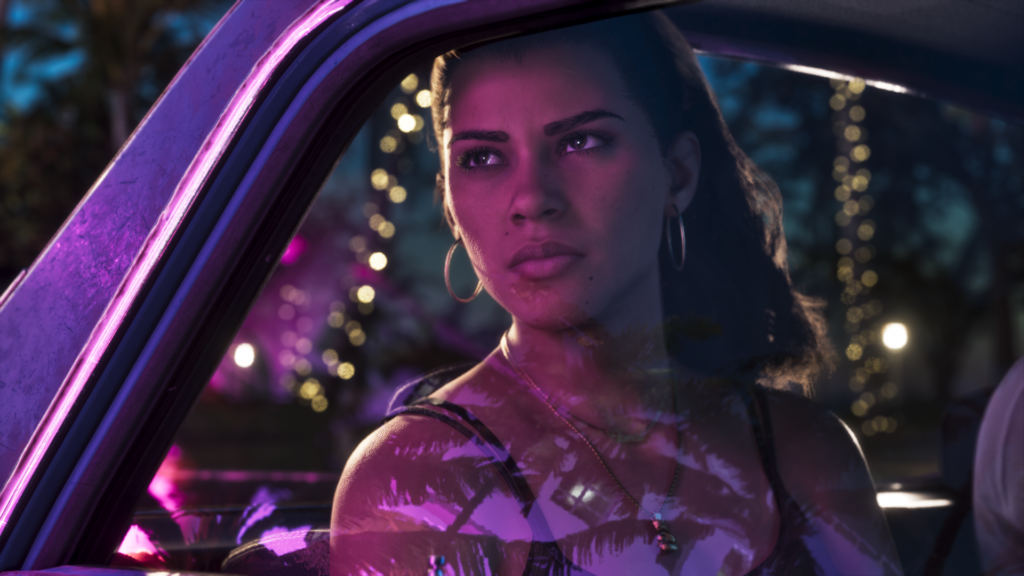
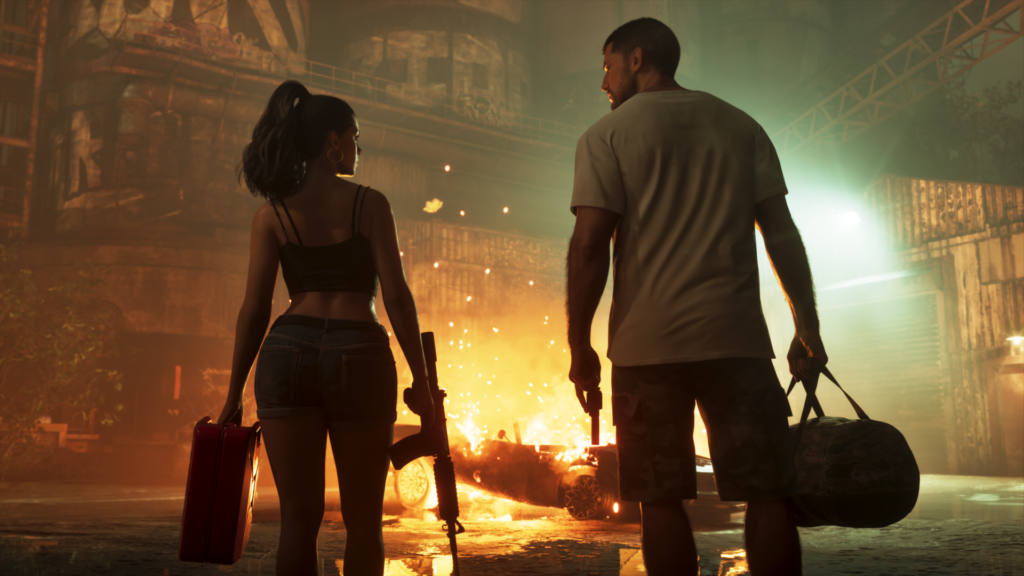
I can feel the Rockstar employees in the room watching my reactions, but keeping a poker face is impossible. Mouth open, eyes wide, I am reunited with Lucia and Jason, the heroes of GTAVI, whom we have gradually come to know through the trailers released over the past two years—trailers that have racked up hundreds of millions of views.
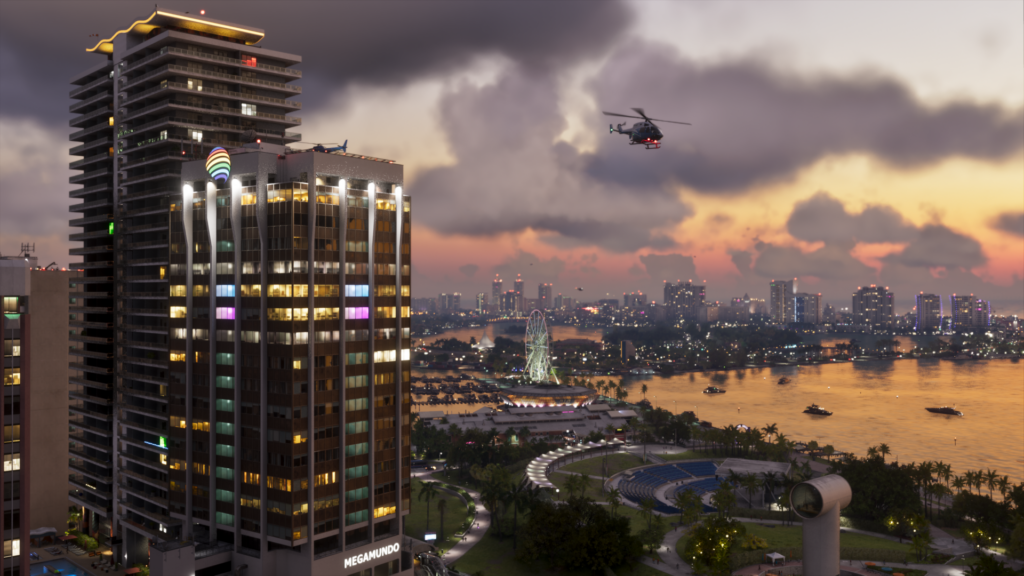
I am plunged alongside them in medias res into a tense drug deal in a Vice City neighbourhood, the fictional metropolis inspired by Miami. The technical mastery everyone has been expecting is there. But what really grabs me is the virtuosity of the direction: the performances, the camera movements, even the choice of virtual lenses. The music builds alongside car chases and gunfights, driven by a groove that draws as much from Cerrone’s flamboyant disco as it does from the French Touch’s.
Between action sequences, quieter, more intimate moments (car rides, encounters with other central characters) begin to sketch out the contours of the plot, all within an intensely cinematic universe that immediately feels coherent and easy to grasp. At its heart are lovers on a run who become caught up in a criminal spiral of dizzying proportions, involving small-time crooks, all-powerful kingpins, outsiders, informants, crooked cops and assorted lunatics. All of it is sharpened by the exhilarating satire of the entertainment and news industries for which Rockstar has become famous.
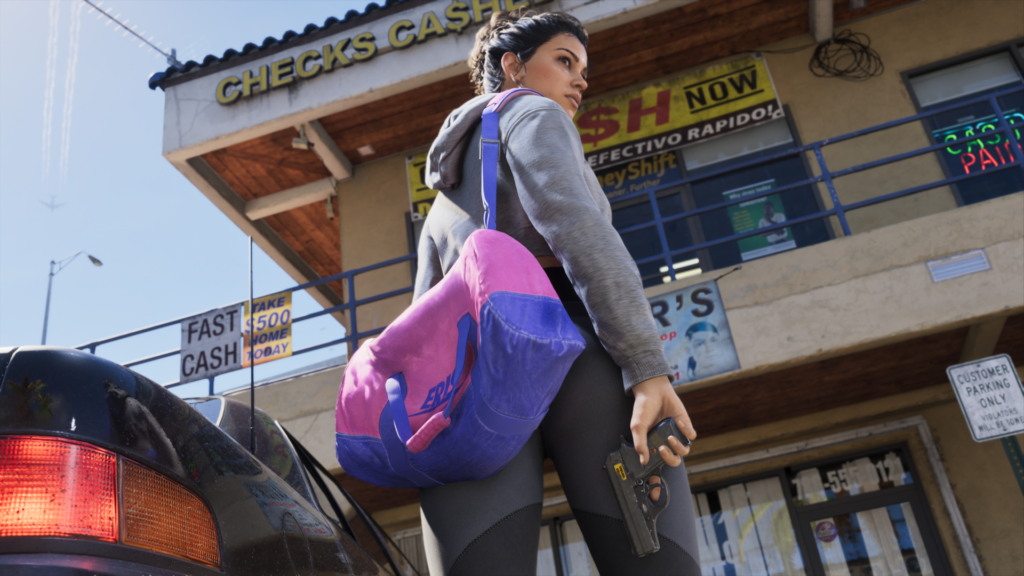
What changes everything is the fact that you play a couple. Their romantic bond gives the player a much stronger emotional investment than before, both during action missions and in the small moments of everyday life. After spending a few minutes walking Lucia and Jason around hand in hand (the animation of the two characters moving together like this is striking) guiding them through a convenience-store robbery suddenly takes on an entirely different dimension. You cannot control one without worrying that something might happen to the other.
In short, what I have just seen of GTAVI is Rockstar at its very best, only even better (see preview). More importantly, the cinematographic excellence packed into these thirty minutes of footage allows us to make a bold prediction: the best movie of the year is a video game.
The only question left is how they did it. So the moment the lights come back on, we bombard Rob with questions.
What was the first image that came to mind when you first started thinking about the game?
There’s a lot of us who start these games together. And we probably have different images in our minds, but we all get on the same page very quickly. It may be an image, often it is a song we rally around. Then it develops as we go on. There might be things that have influenced us, whether fiction, or film, or something from a documentary, but the image develops a little bit as you go on. Certainly though, the first thing we always do, once we decide where we want to set the game, is we’ll go there. And just feel it, and go out and just drive around. Almost always on our own at very first, just a handful of people, and we’ll take a ton of pictures, and soak as much of it up as we can and see what speaks to us and start to talk about it and share ideas about what we want to incorporate. We’ll then go back with a larger group and start meeting with various consultants who will take us all over the place and we start to just build it out like that. So, I’d love to say that it was an image from here that was in our heads, but you’re usually chasing something a little bit out of reach and then you see something, and choose a piece of music, and these two things start to work. The game starts to pull together these sorts of pieces. With the first trailer for this game, the Tom Petty song [Love is a Long Road] was a real sort of mission statement. You don’t have the game fully formed, you have an idea of what it’s going to be, but you really have to push hard to pull that together and so when this team is able to do that – and it’s definitely made with everything that you’ve got, but it’s the best of everything you’ve got at that point – it’s put together in such a way that it helps be a bit of a guiding light of what it needs to feel like.
How do you create the overall flow of your world? Do you start by building a map and then think, “Okay, we need to find a way to get them from this area to that one, so let’s build a story around that”?
So we will figure out where we’re going to set it first. And then, like I said, we will go to that place, so in this case, Florida and Miami, and spend time there deciding what elements we want to incorporate. And then we go, what are the special areas that we want to include? We want to include the Everglades, and we want to include some of these towns outside of Miami. Obviously, we’re going to include Miami. What aspects of Miami do we want to accentuate? What types of people and places go in? And at the same time, our team is blocking out the map and where these things are going to go. And they’re roughly in the same geographical locations as they are in the real world, and they pick out things we want to highlight. So it’s a warped sort of version of reality. And so, we roughly know we have to incorporate these areas in the map and then our writers will start thinking about what’s the best character set to take us through the widest range of places, who can take us to the Everglades, who can manage their way through a drug deal and tower block being raided by cops, who could do high-end glitzy glamourous nightclubs. Which character could possibly take you through that and be believable in each of these environments? That helps form the character set. They are like your tour guides or companions through this world. And so once we have that, and then we have some broad “Yes, we’re going to have to include this part of society or culture, and this part, and this part, and this part.”
Rupert [Humphries, Senior Vice President of Narrative] will start writing, and then he delivers a page and a half of the story: “This is it, they start here, this is their situation. This happens, that causes them to move here, then they stay here for a little bit and do this sort of stuff, then boom, move there.” And so we very consciously have to think about how we’re going to push and pull players through the map, through narrative beats. We then go, “OK, what sort of missions and set-pieces are we going to have there,” and build the locations around that. And then, once we have the big beats of the narrative that will certainly drive the story forward, we’ll start developing these tentpole missions a little bit more. This one is going to be the catalyst that is going to move them from this part of the game to that part of the game. The game is set over chapters, which also help us figure out how the game is going to move. And then, once we have these sorts of tent-pole missions with some different key plot points that are going to happen, I guess then it’s sort of “How is this going to work?” And then, “What if the player does something different, can we allow for it, if the player wants to go off the rails?” So always sort of building it up in layers, and seeing what’s working and what is not.
The big change this time is that we’re drawn into the intimacy of a duo. We’ll also be playing as a female protagonist, which is a first…
Yes, it’s certainly new for this generation of Grand Theft Auto games. We always look back at the last games and think about how to evolve on them and move them forward. And so, with GTAV with three protagonists that were connected but individual in their own way, and then going to Red Dead Redemption 2, which was obviously Arthur’s story, we were slightly nervous people were going to be bored with just one protagonist. And we did have people ask, « Are you going to be able to switch between members of the gang? » There were questions about that. I forgot about that until now. And you think about it, and you know, people speculate. But it feels funny now, because Arthur worked as a character, I think, and we were able to just really drill into his journey, and, obviously, John’s after… and I think the stuff we got to do with Arthur in terms of his narrative arc and how the things that he did and the things that happened to him changed him or not, depending on how you play and the choices you made, in that sort of morality, honour system, had really sort of a big impact on us and our connection with playing as him and I think other people enjoyed with the game as well.
And so, we wanted to take the depth that we were able to add into the world of Red Dead Redemption 2 and the ability to interact with the world in a much more significant way but then also this sort of emotional connection that people end up having with Arthur. Is there a way that we bring that into GTA, and how could we do it? So, we had played around with different ideas, we knew we wanted to come back and continue playing with the idea of multiple protagonists. We thought about different options but ultimately wanted to try a duo, a partnership of some kind. If they’re in relationship, or have the potential to be in relationship, what does that feel like? So it’s a couple, it’s Bonnie and Clyde. And then as soon as we thought about it, it was obvious. It became the very clear choice for us and felt like something we had to try.
I really like that scene made up of little everyday moments in their apartment, as they’re getting ready to go out for dinner. That intimacy makes us much more emotionally invested. During a robbery, you’ll be afraid for the other person, and that’s something I never felt in GTAV. There were three of them, and I was attached to each one, but I never really worried about what might happen to the others…
Yes, when you see her get thrown down the stairs and then you switch to him and you can’t hear her, it’s the feeling of concern. Playing with those ideas and those quieter moments like the one you mention in the apartment that I think a lot of people can identify with. Everyone has relationships and knows what that’s like, and knows what it’s like to be waiting for someone to get ready, and thinking, “Should I hassle them at the door and hurry them up or not?” These are all the sort of ideas that came into mind when we thought about this. You would be them not just in the sort of high-action criminal moments, but in the quieter moments as well. We don’t want to push the relationship on people who may not be interested in it, but we want to give players the opportunity, similar to the way we did with Arthur, where your actions can influence these characters’ journey. Those sorts of ideas were some of the most compelling aspects of Red Dead Redemption 2 and we wanted to see if we could bring some of those elements into GTAVI.
The acting is very convincing. I remember the moment when they leave their apartment and she takes his hand…
It’s all full performance capture.We do have a preview of the game, but they’re working to a set. We would build this set out for any sort of mocap set, and it’s a full performance. We can tell long stories that sort of meander around a little bit, and you can play them at your own pace. This is what we’re very interested in, that sort of semi-interactive element.
You’ve always managed to create games that reflect the societies we live in. Over the course of this game’s production, which lasted several years, the world changed enormously: there was the MeToo movement, the Covid pandemic, terrorist attacks in Europe, wars in the Middle East… Do you keep an eye on all of that and think, “We should try to incorporate this into the game,” or do you just keep moving forward as planned?
That’s a very interesting question. We develop on very long cycles. The game’s been in development since 2015, so the idea is gestating for a long time. The majority of the team really started rolling on to it after Red Dead Redemption 2 released in 2018. We have to be very careful about what ideas we choose to put in there, because it can take a long time to figure out what our angle is on this. Because by the time we write it and cast it and shoot it, and implement it, whatever it is – it could be gone, it could change, it could be dated. And so we’re always trying to think about whether something will stand the test of time. And so, you look at those things, and we only try to pick things if they work with the story we’re trying to tell, in the world we’re trying to tell it in. I think there will always be things to satirise, there are always ridiculous situations and behaviours that we can find, but we just have to be careful about what we pick.
I actually replayed a few hours of GTAIV before coming here: it still feels very relevant—or at least, it hasn’t aged badly…
I went back to GTAIV for similar reasons, and they feel like the games are sort of like living little time capsules of what it was like then. And so I try to think about that a little bit as we approach ideas here, it will feel hopefully in 10 years’ or 20 years’ time, very much like coming back to this sort of era. And who knows what the world will look like, but hopefully, when you come back, it won’t be too specifically about something that was short-lived, but it will feel like, « Oh yeah, I remember those influencers and those streamers and the sort of stupid challenges and things they did,” and whether they’ll still be doing them, or whether the world will have moved on to something else we don’t know, but I think they represent all the sort of human craziness and silliness of this time. I think that will be represented well here.
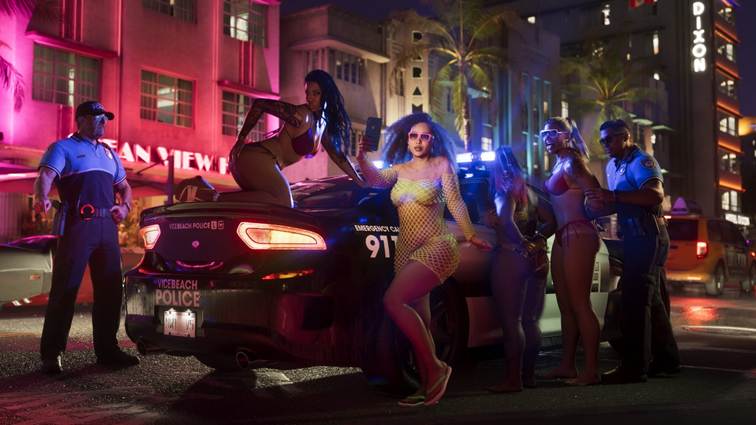
We’ve just seen a lot of very different gameplay sequences—driving and gunfights of course, but also scuba diving and workout sessions…
Because there is so much to do, and so many ways to do it, it’s a very watchable experience, so, hopefully that will come across. There’s a far greater level of interactivity in this game than there was in GTAV, more than in Red Dead Redemption 2 as well. So, you know, roleplay elements for people who like that sort of thing. The safe houses, for example, are places that you should hopefully feel like you’re inhabiting.
The camera work is particularly impressive, especially in the seamless transitions from an open environment like a street into a much tighter space such as a stairwell. It goes beyond what you could achieve with camera lenses on a film set…
The sequence of them walking into the elevator, that’s from in-game [meaning a moment when the player is in control, Ed.]. Something we’re always working on is how do we transition from player control into a cutscene or semi-player control. We want to make it feel cinematic and then go back out into them walking out through the hall, petting the dog, knocking on the door, into a full cutscene, then into gunfight gameplay [when the player has full control of the character, Ed.].
In your games, the most cinematic moments happen during gameplay rather than in cutscenes. You really feel like you’re playing through the most spectacular moments yourself.
We’ve been working on that for a long time. I think when that probably started was GTAIV and the Episodes from Liberty City and the jump from that to Red Dead Redemption. That’s when we started to say, how do we get rid of the fade to black from gameplay to cutscene? It was very jarring and when you played we felt it was still two experiences: the gameplay and the scene. In games before Red Dead Redemption, previous GTAs and our other games, generally, cutscenes would often be inside a building. You hit the door, cut inside, have a little chat, and then be outside, or there would always be a fade as we loaded in the cutscene. And in Red Dead Redemption, you would walk into the scene, and then walk out of the scene. Marston would walk out of the scene, and the camera would catch up, and keep it moving, and it would be seamless. And we’ve been pushing that ever since, but at the end of Red Dead Redemption when Marston goes to face his fate…
In front of the barn… [No spoilers here—go play Red Dead Redemption, Ed.]
Yes. So, I remember seeing a rough version of that scene for the very first time. He would go to this door, and it was a cutscene. And we were like, this is going to be very powerful, but it would be more powerful if, because I’m the player, I do the shooting. If we could put it on stick [in player control] and in the player’s hand, it completely changes the scene – especially as it’s a futile attempt. And so, we keep pushing in that respect, to where we are now. Those things were done a little bit retroactively on Red Dead Redemption, once we had the mocap done and it was a scene, we could say let’s pull it out and put the player in partial control. We designed things like that in Red Dead Redemption 2, where the whole gang goes to get Jack back. You’re in partial control during that sequence, because whilst you could have a cutscene, we felt it would be more powerful if you were walking with the gang. You can’t run away and you don’t have total agency, but you’re part of it. We are always trying to play with those ideas. You’ll have seen that here a lot. When Jason is in the conference room with the guy named Andres doing coke off the building model, you have some control there – you can move back and forward and the camera is pushed in, but you’re not totally locked in, and it’s not a cutscene. We try to play with that all the time.
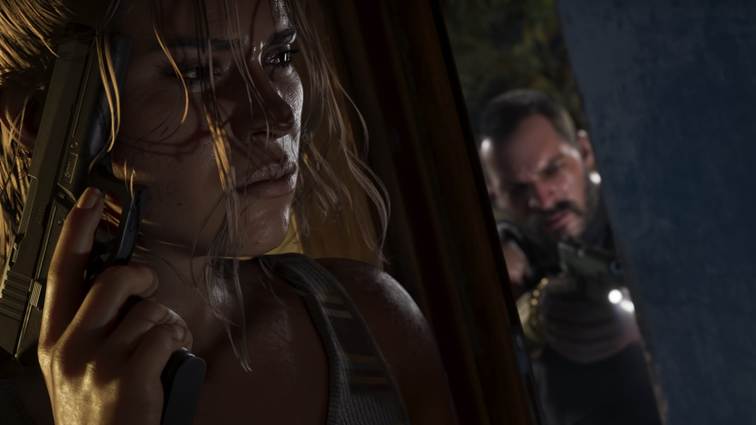
Visually, your games don’t simply strive for photorealism. At times, they seem much closer to animation, in a way. There’s something deeply rooted in comic-book art about them, and I think that’s precisely what allows us to enter this world without stepping into the Uncanny Valley [the “uncanny valley” is a concept which, to put it very simply, explains why we can feel uneasy when faced with images or objects depicting photorealistic humans, Ed.].
Yes, that’s something that we often talk about wanting and needing to stay on the right side of. As technological capabilities have increased, so has the ability to make something look very real. It has to look better… but you have to find your own angle on it. And it is subtle. It is subtle, but it’s not fully realistic, and that’s not the goal. It’s the same with gameplay – the goal is not to be realistic, it’s to feel realistic and appropriate for what we do, but not to slow things down unnecessarily.
We also saw a type of sequence that comes up often in your games: conversations while driving. It’s a trope you often find in cinema too (Abbas Kiarostami, Jafar Panahi, Jim Jarmusch). A car is one of the best places to talk, and to get people talking.
And that’s sort of more comfortable… You hear sometimes, « Oh, it’s easier to have a difficult conversation with someone in the car,” or something similar. I’ve heard that, too. So there is something in that. And yeah, we love that. Obviously, there’s a lot of driving in the game. We’ve always had a version of driving and conversations – like in Red Dead Redemption, but that’s on horses instead. It’s a great way for us to get more exposition across, and sneak in some exposition in there that might be, again, probably for the same reason, awkward or a bit forced or clumsy in a cutscene.
How would you like people to remember these games in a hundred years?
That’s a good question. I think if they remember them in a 100 years, I’ll be happy about that. I guess I hope they will think they were entertaining? That they were a funny snapshot of who we were and what it was like to live in our time and through a sort of satirical, skewed lens.I hope that when and if they play it, they find it entertaining and they laugh a bit and see how we laughed at ourselves during our time in the world.
EXCLUSIVE GTAVI PREVIEW: OUR FIRST MINUTES IN THE GAME
After our exclusive interview with him, Rob Nelson, Head of Development at Rockstar North, took us on a controller-in-his-hand tour of Grand Theft Auto VI. An exceptional experience that we describe in detail here.
Rob picks up the controller and invites me to ask him to do and show me anything I want. Over the next hour or so, he regularly slips small instructions and remarks to a colleague standing behind him. These are the final adjustments: an affectionate gesture between the two protagonists that is a little too slow, a traffic cone that is a little too heavy when hit by a car… I am watching master craftsmen put the finishing touches on their masterpiece in real time. It is every bit as fascinating as the spectacle unfolding in front of us. They are not presenting the game to me, we are testing it together.
We find Jason in his apartment, then follow him through the streets of Vice City, populated by a staggering number of characters who stand out for the subtlety of their character design and the richness of their interactions, both with one another and with our hero. Wondering whether I think it is good? Whether all of this was worth more than a decade of waiting? Absolutely. I have the same feeling I had after seeing a presentation of the first 15 minutes of James Cameron’s Avatar in 2009. It is so well made that it immediately becomes a new benchmark, a pinnacle of achievement: you stop pinching yourself over every detail (the sand on your shoes, the sweat on your skin after a sprint, the way aquatic plants float in the water) and start focusing on what might actually happen within this extraordinary setting.
After chatting for a while with a few locals out enjoying themselves along the beach, we swim over to a luxury villa where a bunch of bitcoin bros are having a barbecue. We are not invited, tempers flare, punches are thrown and the police are called, so we make a run for it. Rob talks me through the game mechanics. “So then they know what I’m wearing, but if I’m in a car, they didn’t see me get it, I should be able to pass. So the law is much smarter and the systems are much more sophisticated than GTAV. So if you be careful and keep moving, it’s doable, which reinforces the narrative, which is that it’s about a couple on the run. So you can take your chances, or be more careful, you can sort of choose what sort of criminal you want to be, a more professional one, or more of a loose cannon. And how you play may have an impact on some things”. Similarly, he explains that the way Lucia and Jason behave towards each other affects their relationship. Do they look out for their partner? Do they spend time together? The RPG elements and customization are important. “The world is also a lot more unpredictable. You’re not the only person with guns, you’re not the only person capable of violence.”
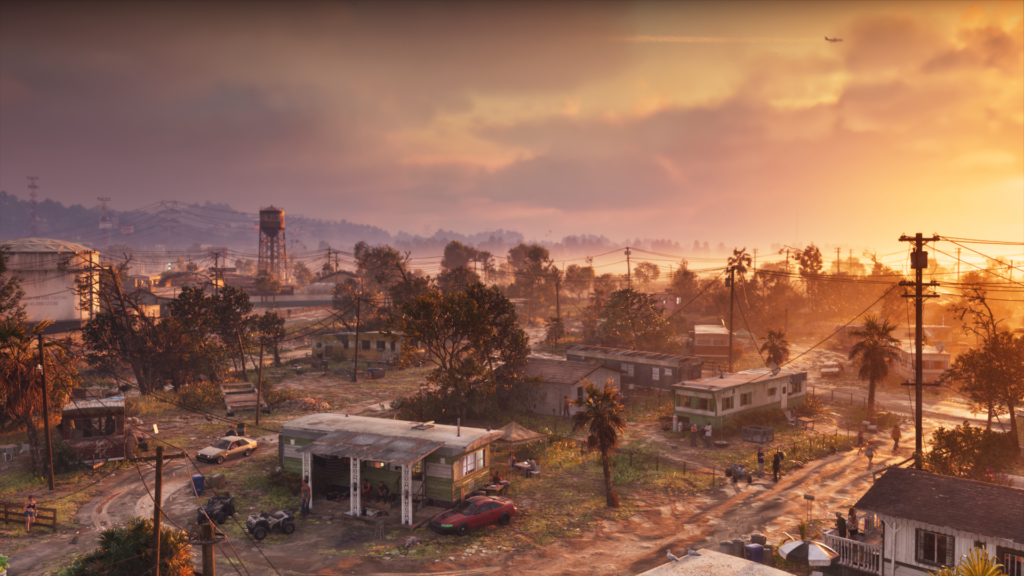
“Vice City is twice the size as Los Santos”
Jason hops onto a scooter. As a joke, I suggest he should be putting on a helmet. No problem, they have thought of everything: “You just press this button.” The city rolls by until we come across a gas station. We go inside to rob the cashier, who tries to stall before thinking better of it. “The cash is actually also vulnerable. You have a bank account and cash now. And so if I get wasted, and I don’t deposit it, it’s gone. Yes, so I’ll find an ATM.” Rob explains that GTA VI is set in the present day. Then he asks me where I would like to go. “Can you show me some nature, the countryside?” He opens the map. It is huge “Vice City is twice the size as Los Santos [GTAV main city], but the number of built-up towns outside the city is 11 times the size of GTAV in terms of the little towns you can come across! So you start way down here in the Keys for the first part of the game, and that’s Jason’s little house that you see in Trailer 2. And then the game just opens and you can go anywhere, anytime.” And what about the buildings? “You can enter a lot of buildings, a lot, a huge number.” Among the small features that enriched the gameplay this afternoon, I could mention, in no particular order: a visit to the hairdresser (giving you endless ways to customize your avatar), browsing a social network (the game’s intertextuality is dizzying), walking arm in arm (just for the fun of it). The immersive potential is enormous.
We are now playing as Lucia. The couple gets into a car and we head out for a drive in the countryside. We take a street we drove down a little earlier. The traffic is much heavier. “It is rush hour” Rob points out. Like I said, they have thought of everything. Along the way, we stop to watch people diving off a bridge. They challenge us to do the same. Lucia and Jason oblige, jumping hand in hand. It was a trap. Our car gets stolen. “There are many emergent events that change the course of things.”
Completely absorbed in my search for a new vehicle, I’m surprised I didn’t notice the scenery changing. Almost imperceptibly, we went from the heart of Vice City to the suburbs, then out into farmland, without ever having to drive for what felt like forever. “It was very challenging on Red Dead because it’s a smaller map and with a lot of different sorts of regions and biomes that you have to traverse through and the way they had to blend them. The team gets better every time. They do it in a way that feels natural, but it’s not one-to-one life-size.” Among the technical feats of this world unfolding before us are the reflections (mirrors, shop windows, puddles), which are always a challenge in this kind of game. Another is the handling of depth of field as we drive through an iridescent orchard at sunset: every leaf seems to be made up of a skillful interplay of blur and sharpness, letting through just the right amount of shadow and light to make the illusion complete.
During our eventful drive, we carried out two store robberies and neither unfolded in the same way: the shopkeepers’ reactions, customers getting involved, the police response… Every situation is open-ended. “You never know what you’re going to find!” Rob sums up. The sun disappears below the horizon, giving us time to discuss the humorous side of their games, particularly their satire of the media and other forms of communication. “There are a lot of people working on lots of different things, brands, billboards, TV shows. If we can find a playful angle on something, and it fits in the world, it works. A lot of it is trial and error. Certainly, for the media stuff, it’s like, “Is this working?” The team pitches a lot of ideas, and we try and see if it works.” In GTAVI, TV commercials naturally feature blood-soaked burgers made with 38 beef patties, while streamers take on live challenges from inside the trunk of a stolen car.
We are now deep in the countryside as night falls. We are surrounded by soothing greenery, and the flashy swimsuits of Vice City already feel far away. A new world opens up before us.
◆◆◆
Grand Theft Auto VI (Rockstar Games),
Released on November 19th
◆◆◆